
4 Step Lease Renewal Workflow and Template for Property Managers

4 Step Lease Renewal Workflow and Template for Property Managers
A lease extension addendum keeps the current lease alive with a new end date and, at most, a small change to rent or a handful of terms. Use it for short-term continuity or minor adjustments. A full renewal replaces the lease entirely and is the right tool when rent, term length, or policy changes are substantial.
TL;DR:
- Using a lease extension addendum is best for short-term renewals with minimal changes, especially when rent remains stable or only slightly adjusts.
- Drafting a valid addendum requires explicit mention of the new end date, rent details if changed, and a reference to the original lease to avoid disputes.
- E-signature tools provide enforceability and a reliable audit trail, but signatures should be collected before delivering the signed document to tenants.
- An extension maintains existing lease terms, making it suitable for brief tenant stays, while a renewal is better for significant policy or rent changes.
- Proper timing of renewal discussions, ideally 60 to 90 days before expiration, and clear, proactive communication increase the likelihood of prompt acceptance.
Table of Contents
- What Goes Into a Lease Renewal Addendum Template
- How Do You Draft and Execute a Lease Extension Addendum?
- When Should You Use an Extension Instead of a Renewal?
- Key Clauses Every Lease Renewal Addendum Needs
- Signing, Delivery, and Where to File the Paperwork
- When to Start the Renewal Conversation
- Where Vemlio Fits Into Your Renewal Workflow
- Common Pitfalls That Weaken a Lease Renewal Addendum
- Residential Versus Commercial Lease Renewal Addendums
- How a Renewal Addendum Changes Tenant Rights and Obligations
- Negotiation Tips for Renewal Addendum Conversations
- What Actually Moves the Needle on Renewal Acceptance
- Turn Addendum Paperwork Into a Repeatable System
- Sources
What Goes Into a Lease Renewal Addendum Template
A usable addendum has a short list of required fields, and missing even one creates ambiguity later. Start with the simplest version, then layer in rent changes only when the situation calls for it.
Minimal extension-only template should include:
- Names of landlord and tenant exactly as they appear on the original lease
- Property address and unit number
- Original lease date and current end date
- New end date (the sole substantive change)
- A clause stating all other original lease terms remain in full force
- Signature lines with printed names and dates for both parties
Extension with rent adjustment needs everything above, plus a clause spelling out the previous rent, the new rent, and the exact effective date of the change. Vague phrasing like “rent will increase slightly” invites disputes; state the dollar figure and the date it takes effect.
| Field | Extension-only | Extension with rent change |
|---|---|---|
| New end date | Required | Required |
| Rent language | Not needed | Previous and new amount, effective date |
| Signatures | Both parties | Both parties |
| Reference to original lease | Required | Required |
Before sending either version, check the original lease for auto-renewal language or a clause that already dictates renewal terms. An addendum that contradicts an existing clause can be challenged later.
How Do You Draft and Execute a Lease Extension Addendum?
Executing an addendum correctly takes four steps, and skipping the first one is the most common source of trouble down the line.
- Gather originals and audit the lease. Pull the signed lease and any prior amendments. Look specifically for auto-renewal clauses, rent escalation language, or notice requirements that might conflict with what you’re about to draft.
- Choose extension or renewal, and decide on terms. If you’re only pushing out the end date or making a small rent tweak, an extension addendum is the leaner path. If rent, term length, or policies are changing meaningfully, draft a full renewal instead.
- Draft and attach. Write the addendum so it explicitly references the original lease by date and parties, then prepare it for signature routing, either through an e-signature platform or in person.
- Execute, deliver, and file. Collect signatures from all parties, deliver copies to the tenant, and attach the signed addendum to the original lease in your records system.
Pro Tip: Never rely on a verbal “yes, we’ll extend” from a tenant. A signed, written addendum attached to the original lease is what makes the extension enforceable if a dispute comes up later.
When Should You Use an Extension Instead of a Renewal?
The legal difference matters more than it looks at first glance. An extension continues the existing contract, so covenants, liabilities, and prior terms generally carry forward unless you specifically change them. A renewal creates a new contract, which can reset or extinguish certain original terms unless the new document says otherwise, a distinction courts have drawn explicitly when disputes reach litigation.
Extensions work well when:
- The tenant is staying short-term (a few months to a year) with no major changes
- You want to retain a good tenant quickly without renegotiating the whole lease
- Rent is staying flat or moving by a small, defined amount
Renewals make more sense when:
- Rent needs a meaningful reset to match market conditions
- You’re committing to a new multi-year term
- Policies, pet rules, or other lease-wide terms need an overhaul
If you’re unsure which applies, default to the smaller intervention. An extension addendum is easy to draft and, if circumstances change again in six months, easy to revisit.
Key Clauses Every Lease Renewal Addendum Needs
Enforceability comes down to precision. Vague language is the number one reason addenda get challenged or misread months later.
- Term extension: State the new termination date plainly, e.g., “The lease term is extended through March 31, 2027.” Avoid relative phrasing like “extended by six months,” which forces someone to do math against the original date.
- Rent: If unchanged, say so directly: “Rent remains $1,850 per month, unchanged from the original lease.” If changing, state old amount, new amount, and effective date together in one sentence.
- Security deposit: Confirm the existing deposit carries forward under the original terms, unless you’re specifically adjusting it.
- Reference to the original lease: Every addendum should open with a line identifying the original lease by date and parties, and close with a clause confirming all other terms remain in effect except as modified here.
- Signatures and dates: Both parties sign and date the addendum itself, separate from the original lease’s signature block, with the effective date of the addendum stated near the top.
Signing, Delivery, and Where to File the Paperwork
E-signature platforms provide sufficient legal evidence for most residential addenda, and they come with a real advantage over pen and paper: an audit trail that timestamps who signed, when, and from what device. That record matters if a tenant later disputes whether they agreed to the terms.
Wet signatures or a witness still make sense in a few edge cases: high-value commercial leases, situations where local rules require notarization, or when a tenant lacks reliable access to e-signature tools.
Whichever method you use, attach the signed addendum directly to the original lease file, digital or physical, and hold onto it for the full length of your standard lease-document retention period. A renewal history that’s scattered across email threads and file folders is exactly what creates confusion at move-out or during a legal dispute.
When to Start the Renewal Conversation
Timing determines whether you get a smooth signature or a scramble. Industry practice points to a 60 to 90 day window before lease expiration as the point to send the first offer.
- 60 to 90 days out: Send the initial offer with proposed terms and a clear sign-by date.
- 45 days out: Follow up if there’s no response. This is also the point to flag the file if you need a backup plan.
- 30 days out: Final follow-up. If the tenant still hasn’t responded, decide whether to extend the deadline, prepare a non-renewal notice, or begin marketing the unit.
- 14 days out: All paperwork should be signed and filed by this point, with copies delivered to the tenant.
Some jurisdictions require notice within specific timeframes and proof of delivery, such as certified mail, so confirm local rules before finalizing your outreach template. A one-page checklist mapping each of these dates to a task, assigned to a specific team member, keeps this from falling through the cracks across a large portfolio.
Where Vemlio Fits Into Your Renewal Workflow
Vemlio functions as a decision layer for renewals: it analyzes rental market data, tenant history, and prior performance to recommend rent figures, terms, and timing, then routes the resulting addendum through e-signature. It’s built to sit alongside your existing property management system rather than replace it.
For a broader look at the mechanics of running renewals at scale, the step-by-step renewal process guide walks through the full workflow, and the renewal strategy resource covers timing and rent decisioning in more depth.
Common Pitfalls That Weaken a Lease Renewal Addendum
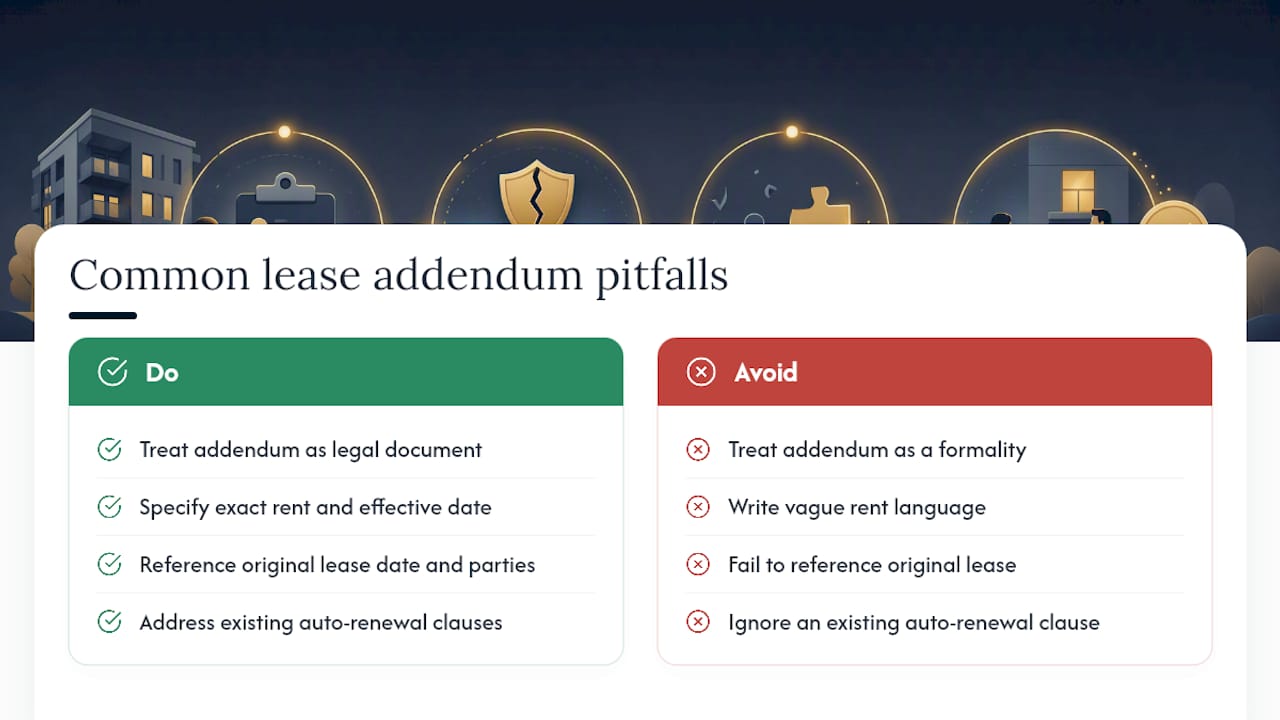
The most frequent mistake is treating the addendum as a formality instead of a legal document. A few specific errors show up again and again.
Vague rent language tops the list. Writing “rent will be adjusted” without stating the exact figure and effective date leaves room for disagreement the moment a tenant questions their next bill.
Forgetting to reference the original lease is a close second. An addendum that doesn’t explicitly name the original lease by date and parties can be read as a standalone document, which muddies which terms actually apply.
Skipping the auto-renewal check causes real headaches. If the original lease already contains an auto-renewal clause, drafting a new addendum without addressing it can create two conflicting sets of terms covering the same period.
Using verbal or informal confirmation in place of a signed document is a mistake that only surfaces when there’s a dispute, at which point there’s nothing enforceable to point to.
Applying commercial language to a residential lease, or vice versa, is another common slip. Commercial addenda often carry different notice and indemnification language that doesn’t translate cleanly to residential terms.
Missing state-specific notice requirements rounds out the list. Some jurisdictions mandate a minimum notice period or a specific delivery method before a renewal offer is even valid, and this varies enough by state that a one-size-fits-all template can create compliance gaps.
Residential Versus Commercial Lease Renewal Addendums
Residential and commercial addenda share a basic structure but diverge in what they need to cover. A residential lease renewal addendum is typically short: new end date, rent language if it’s changing, and a reference clause back to the original lease. Most residential leases run month-to-month or year-to-year, so the paperwork stays simple by design.
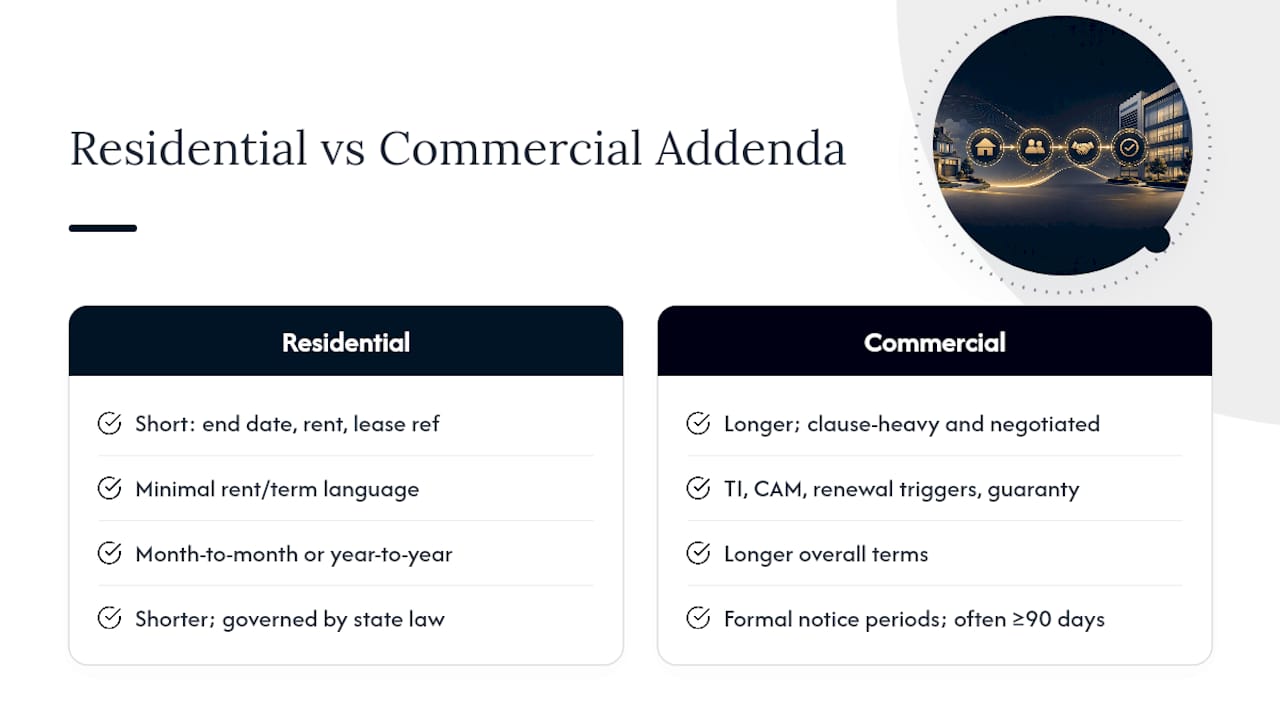
Commercial addenda tend to carry more weight per clause. Terms like tenant improvement allowances, common area maintenance charges, renewal option triggers, and personal guaranty language often need to be addressed explicitly, since commercial leases are longer and more heavily negotiated to begin with. A commercial extension might also need to specify whether an existing personal guaranty carries forward, something residential leases rarely include.
Notice requirements differ too. Commercial leases frequently spell out formal notice periods, sometimes 90 days or more, with specific delivery methods required for the notice to count. Residential notice periods are usually shorter and governed more by state landlord tenant law than by the lease itself.
The practical takeaway: don’t repurpose a commercial template for a residential unit or the reverse. The clauses that matter most in one context are often absent entirely from the other, and forcing a mismatch increases the odds that something important gets missed.
How a Renewal Addendum Changes Tenant Rights and Obligations
Signing an addendum doesn’t wipe the slate clean. Because an extension continues the original lease rather than replacing it, tenants generally keep the same protections and obligations they had before, security deposit terms, maintenance responsibilities, and any rights specific to their jurisdiction carry forward unless the addendum states otherwise.
This continuity cuts both ways. Tenants retain protections they’ve already accrued, but they also stay bound by obligations they might have hoped would reset, like restrictions tied to prior lease violations. A renewal, by contrast, creates a new contract, which means it’s the moment to formally update or remove terms that no longer apply.
Tenants should read the addendum closely for one specific thing: any clause that says something differs from the original lease. Everything not explicitly changed stays in force, so the burden is on both parties to confirm the addendum’s language actually reflects what they agreed to verbally. A tenant who assumes a policy changed just because the lease was extended, without it being written into the addendum, is operating on a mistaken assumption that can cause friction later.
Negotiation Tips for Renewal Addendum Conversations
Renewal negotiations go smoother when both sides know what’s actually on the table before the conversation starts. Landlords benefit from leading with data: a proposed rent figure grounded in current market comparables lands better than a round number pulled from a general sense of “market rate.”
Tenants, for their part, get more traction by raising concerns early, ideally at the 60 to 90 day mark rather than a week before the deadline, since a landlord with more runway has more flexibility to work with.
A few practical habits help on both sides:
- Put every counteroffer in writing, even informal ones, so nothing gets lost between a phone call and the final addendum.
- Separate rent discussions from term discussions. Bundling a rent increase with a longer term into one negotiation can stall talks that would move faster if split into two decisions.
- Set a clear response deadline in the initial offer so the conversation doesn’t drift indefinitely.
- Document any verbal agreement immediately in a follow-up email before it’s formalized in the addendum itself.
For landlords managing several units at once, consistency across offers matters. A tenant who learns a neighbor got better terms for a similar unit, with no clear justification, is far more likely to push back or walk. Tying rent recommendations to actual market and retention data, rather than a manager’s gut feel, removes a lot of that friction before it starts.
What Actually Moves the Needle on Renewal Acceptance
Clarity and timing beat clever language every time. Tenants sign faster when the addendum states rent, dates, and what’s unchanged in plain terms, sent early enough that they don’t feel rushed. One shortcut worth stealing: lead your offer email with the new rent and end date in the first sentence, not buried in an attachment. For teams scaling this across a portfolio, the renewal playbooks are worth a look.
— Dominik
Turn Addendum Paperwork Into a Repeatable System
Drafting a clean addendum solves one renewal. Vemlio solves the other 200 sitting in your portfolio. It works as a renewal operating system that sits on top of your existing property management setup, pulling market and tenant data to recommend rent figures and timing, then routing the finished addendum through e-signature so nothing sits unsigned in someone’s inbox.

Instead of rebuilding your workflow, you add a decision layer to what you already run, which means your team gets defensible rent recommendations and a signed paper trail without a system migration. If you want a sense of what a stronger renewal rate is actually worth to your portfolio, the renewal ROI calculator gives you a number in a few minutes, and it’s a reasonable place to start before requesting a full walkthrough of the platform.
Sources
- Lease renewal versus extension
- Lease Extension Addendum
- Lease extension vs renewal: Know the differences
Recommended
Explore Vemlio's renewal pipeline, document intelligence and explainable pricing in a free, resettable sandbox.
Enter the Sandbox