
Turn AI Lease Abstraction into Renewal Actions in Minutes for CRE Teams

Turn AI Lease Abstraction into Renewal Actions in Minutes for CRE Teams
AI lease abstraction uses optical character recognition and language models to pull dates, rent schedules, and key clauses out of lease PDFs and turn them into structured, source-linked data in minutes instead of hours. It works well for high-volume portfolios, acquisition due diligence, and compliance prep, but complex clauses (percentage rent, co-tenancy, unusual escalations) still need human review before that data drives a financial decision.
TL;DR:
- Automated extraction performs well on standard lease data but still requires human review for complex clauses like percentage rent and co-tenancy.
- Proper normalization, amendment reconciliation, source linking, and confidence thresholds are essential to ensure accuracy and reduce legal or financial risks.
- Output formats such as CSV, JSON, or direct system feeds support integration but do not replace the need for source verification for high-stakes decisions.
- Cost savings and speed improvements are significant, with processing times dropping from hours to minutes, especially during large portfolio acquisitions.
- Successful implementation depends on thorough testing, complete document sets, and clearly defined reviewer workflows to minimize extraction errors.
Table of Contents
- How AI Lease Abstraction Works: Ingestion, Extraction, and Verification
- What Fields and Output Formats to Expect from an Abstract
- Benefits and Typical ROI: Time, Cost, and Downstream Value
- Accuracy, Limitations, and Best Practices to Minimize Risk
- Implementation Checklist and Evaluation Questions for Adoption
- Vemlio Perspective: Turning Abstracted Lease Data into Renewal Action
- Where Vemlio Fits After Lease Abstraction
- Sources
How AI Lease Abstraction Works: Ingestion, Extraction, and Verification
The process starts with document ingestion. Scanned leases, signed PDFs, and amendment stacks get run through OCR to convert images into machine-readable text, then normalized so dates, currency, and formatting follow one convention across the portfolio.
From there, extraction splits into two tracks. Deterministic parsers handle structured, predictable fields like lease start and end dates or square footage, because those follow patterns that rules-based logic catches reliably. Complex language, like a rent escalation tied to a CPI formula or a co-tenancy clause with conditional triggers, needs the reasoning power of large language models or NLP. Combining both approaches, sometimes called hybrid extraction, tends to outperform either method alone on messy, real-world lease language.
The workflow that separates a usable tool from a risky one comes down to a few checkpoints:
- Source linking: every extracted field ties back to the exact clause and page it came from, so a reviewer can verify in seconds rather than rereading the whole lease.
- Confidence scoring: the system flags fields it’s uncertain about, directing human attention where it’s actually needed instead of everywhere equally.
- Amendment reconciliation: base leases and amendments get merged into one current, effective abstract rather than left as separate documents.
- Human-in-the-loop review: a person signs off on flagged or high-risk fields before the data moves downstream.
That last step isn’t optional friction. It’s the mechanism that catches the mistakes automated extraction alone would miss.
What Fields and Output Formats to Expect from an Abstract
A useful abstract covers a standard set of fields regardless of vendor: tenant and landlord names, term start and end dates, base rent and any scheduled increases, escalation formulas, CAM and other recovery charges, renewal or termination options, security deposit amounts, and leased square footage.
Pro Tip: Ask any vendor how they handle amendments before you look at anything else. A lease with five amendments over ten years is a normalization test, not just an extraction test.
Reconciling those amendments matters more than the initial extraction itself. Normalized data means rent expressed consistently as both monthly and annual figures, dates following one calendar convention, and escalation formulas broken into their trigger and rate components rather than left as raw clause text. Skip that step, and portfolio-level reporting breaks the moment you try to aggregate leases from different sources.
Output typically lands in one of a few formats:
- CSV or Excel exports for teams still working in spreadsheets
- JSON for API-driven integrations
- Direct feeds into property management or lease administration systems
One thing worth stating plainly: an abstract is a working summary built for speed, not a legal substitute for the underlying lease. Anyone relying on it for a dispute or a material financial decision still needs the source document.
Benefits and Typical ROI: Time, Cost, and Downstream Value
The efficiency case for AI lease abstraction is the easiest one to make. Realcomm’s reporting on abstraction costs shows processing times dropping from multiple hours per lease under manual review to minutes with automated extraction, with meaningfully lower cost per lease once you’re processing at portfolio scale.
That speed compounds during acquisitions. Due diligence on a 200-lease portfolio used to mean weeks of paralegal or analyst time. Batch processing turns that into a matter of days, freeing staff for the judgment calls that actually need their attention.
Downstream, structured lease data feeds directly into:
- Budgeting cycles that need accurate rent rolls without manual re-entry
- Automated alerts for critical dates like renewal notice deadlines and rent escalations
- Accounting readiness for ASC 842 and IFRS 16 reporting, where lease terms directly affect balance sheet treatment
None of that eliminates the need for manual or legal review entirely. Leases with unusual co-tenancy language, disputed amendments, or litigation history still belong in front of a person with legal training before the numbers go anywhere important.
Accuracy, Limitations, and Best Practices to Minimize Risk
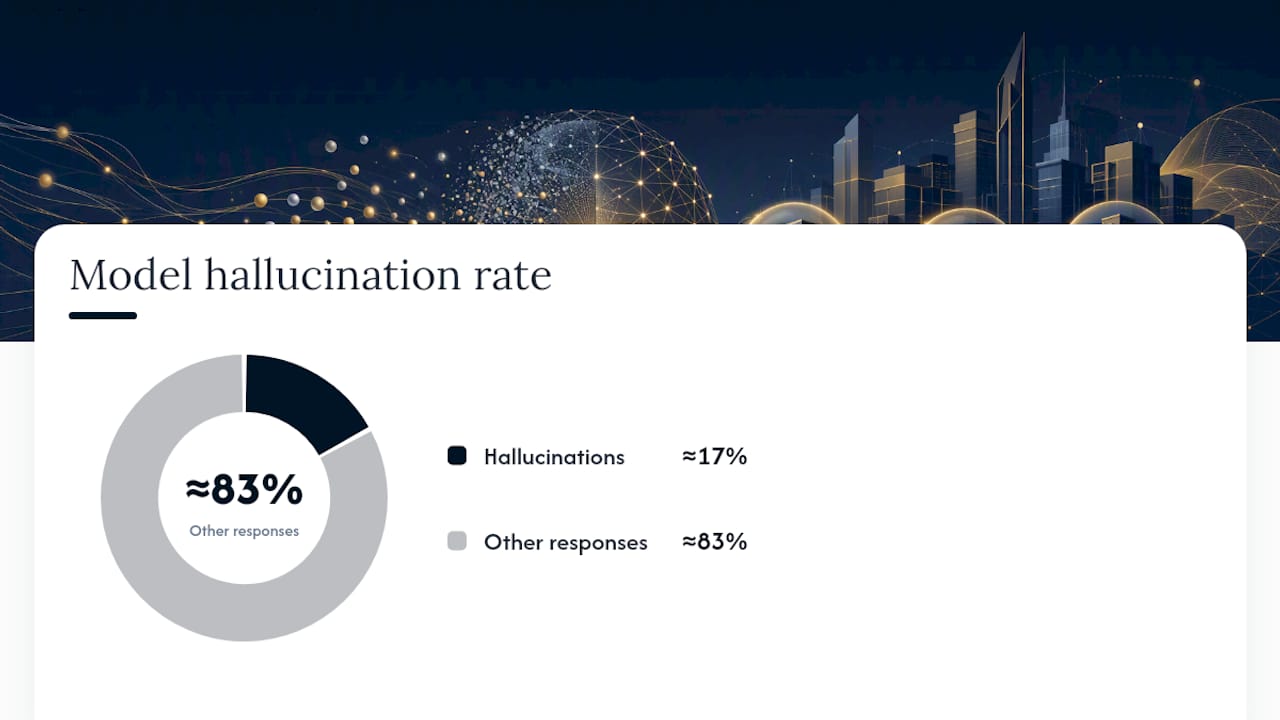
The biggest limitation isn’t extraction speed. It’s the risk that a language model produces a confident, plausible-sounding answer that’s simply wrong. Stanford HAI’s benchmarking found legal-style AI models hallucinate on roughly 1 in 6 or more queries under certain test conditions. That’s not a reason to avoid the technology. It’s a reason to build verification into the workflow instead of trusting output blindly.
A few controls make the difference between a reliable pipeline and a liability:
- Feed the system the complete document set, including every amendment in the correct chronological order. Missing an amendment produces a confidently wrong abstract, not an obviously incomplete one.
- Set conservative confidence thresholds so borderline fields get flagged for human review automatically rather than passed through silently.
- Require source-link verification on every field before it feeds accounting, compliance, or renewal decisions. If a vendor can’t show you the clause behind a number, that’s a red flag.
- Vet vendors on data governance and security certifications, not just extraction accuracy. Lease data includes tenant financial terms that need the same handling rigor as any sensitive business record.
Pro Tip: Treat confidence scores as a triage tool, not a pass/fail grade. A field flagged at 85% confidence still deserves a human glance if it feeds a renewal calculation or a compliance filing.
Implementation Checklist and Evaluation Questions for Adoption
Running a pilot well beats rushing a full rollout. Before you commit budget, work through these steps in order.
- Define target fields and success metrics first. Decide which fields matter most for your workflow, whether that’s renewal dates, escalation triggers, or recovery charges, and set an accuracy threshold you’ll measure against.
- Gather the complete document inventory. Pull every base lease along with all amendments and exhibits. An incomplete set during a pilot will make any vendor look worse than it is.
- Design the pilot around your hardest documents, not your easiest ones. Include leases with percentage rent, unusual escalation formulas, and co-tenancy clauses since testing against edge cases reveals real accuracy limits.
- Build a reviewer workflow before extraction starts. Assign who checks flagged fields, how disputes get resolved, and what threshold triggers a manual escalation.
- Test the integration path, whether that’s a CSV export into your existing system or a direct feed, before assuming it will just work.
- Ask vendors about source linking, export formats, security certifications, and support SLAs as a package, not extraction speed alone.
| Evaluation area | What to check |
|---|---|
| Accuracy on edge cases | Percentage rent, escalation formulas, co-tenancy clauses |
| Source linking | Every field traces back to clause and page |
| Export options | CSV, Excel, JSON, API, or direct PMS feed |
| Security | Data governance policies and certifications |
| Pricing model | Per-lease, per-portfolio, or subscription tiers |
Some vendors offer free trial tools for quick proof-of-concept testing, which can be a reasonable first step, but measure any trial output against your full amendment set before scaling a decision on it.
Vemlio Perspective: Turning Abstracted Lease Data into Renewal Action
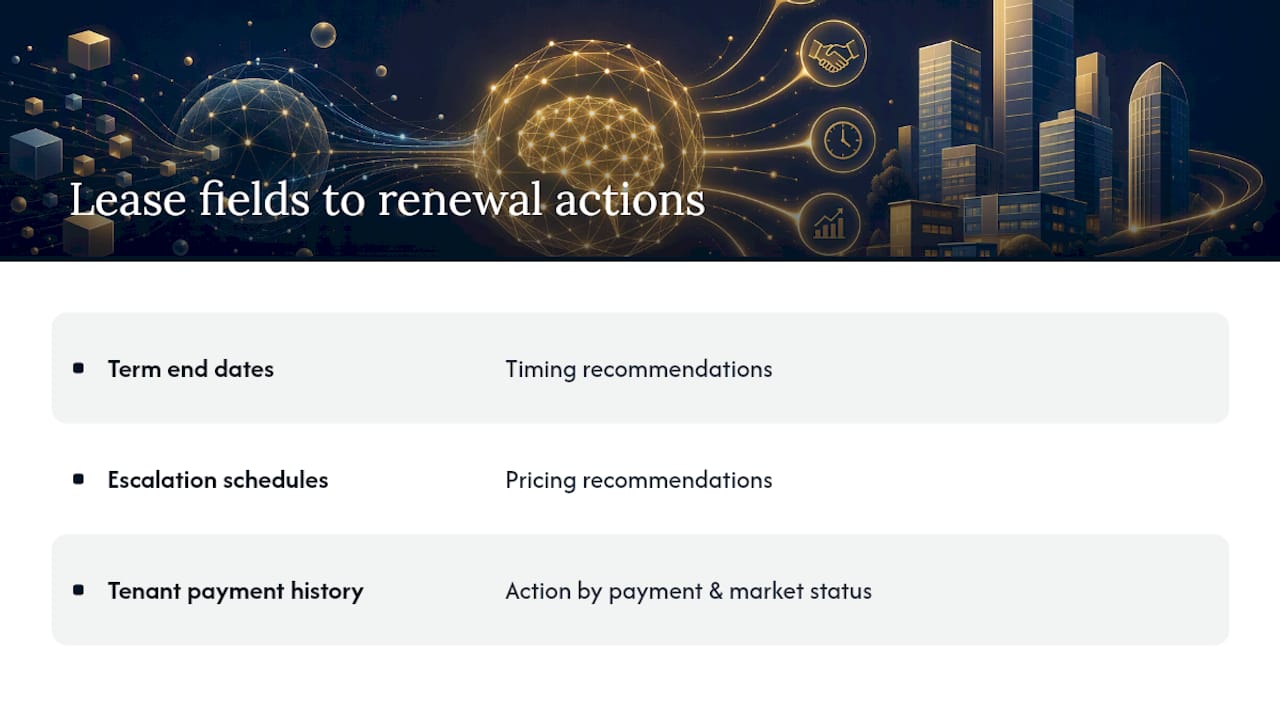
Abstraction solves half the problem. The fields you extract, term end dates, escalation schedules, tenant payment history, are only valuable once they trigger a decision. A renewal that’s 90 days out with a below-market rent needs a different action than one at market rate with a strong payment history, and that’s the layer most abstraction tools stop short of.
At Vemlio, we treat those extracted fields as renewal triggers, not just static records. Term dates feed timing recommendations. Escalation data feeds pricing recommendations. That’s the connection our guide to AI in lease renewals walks through in more detail, including how the step-by-step renewal process turns abstracted data into an executed, e-signed renewal.
— Dominik
Where Vemlio Fits After Lease Abstraction
Abstraction gets your lease data structured. Vemlio picks up from there, turning term dates, escalation schedules, and tenant history into specific rent and timing recommendations for each renewal, backed by rental market data and your own portfolio’s performance history.
Instead of a separate system to learn, Vemlio works as an add-on to your existing property management system through native or CSV-based integration, so the abstracted data you already have gets put to work without a platform overhaul. Renewals move from a spreadsheet guess to a documented, defensible number, with e-signature execution closing the loop. If you’re weighing whether better renewal decisions would move the needle on your portfolio, run the numbers with the renewal ROI calculator using a representative set of your own leases, or see how Vemlio fits your systems before committing to anything.
Sources
- Stanford HAI: AI trial — legal models hallucinate 1 out of 6 or more benchmarking queries
- Realcomm: How AI lease abstraction reduces costs
- What Is Lease Abstraction? Complete Guide | LeaseParse
Recommended
Explore Vemlio's renewal pipeline, document intelligence and explainable pricing in a free, resettable sandbox.
Enter the Sandbox